
#25 | Ten Seats, Ten Islands: What a Seaplane Ride Revealed About Modern Life
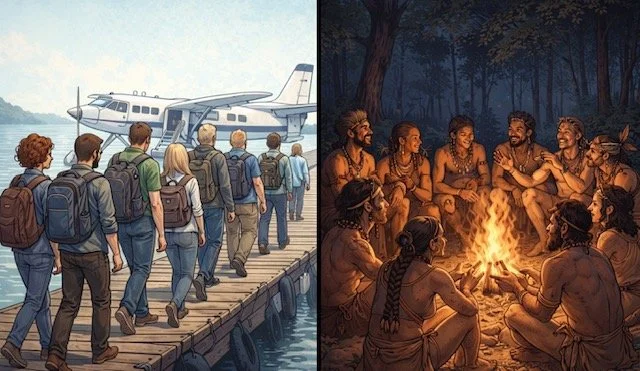
This week I flew in a seaplane that holds ten people.
Nothing dramatic happened. No emergency. No near miss. Just ten humans walking down a wharf toward a small plane—close enough to hear each other breathe, close enough to share the same wind, the same salt air, the same fragile trust that this machine will lift us all into the sky.
And yet, what I noticed felt strangely unsettling:
Everyone was in their own bubble.
Heads down. Eyes forward. Bodies moving like polite robots—near each other physically, but socially spaced out as if we were a mile apart. Not hostile. Not rude. Just… absent. Sealed. Detached. Each person carrying an invisible “Do Not Disturb” sign, like it’s the default setting of modern life.
We live in an advanced social-media society, but the social aspect is often shallow. We’ve mastered communication tools while quietly losing the skill and ritual of connection.
And the cost is showing up everywhere.
The psychological problem we keep mislabeling
As a seasoned psychologist might tell you, many of our modern “mental health issues” aren’t purely individual disorders. They’re often predictable responses to an environment that deprives the nervous system of what it evolved to expect.
Humans didn’t evolve to be emotionally self-sufficient islands.
For thousands of years, we lived in tribes—small bands where:
you were seen every day
your mood had witnesses
your story mattered
your presence affected the group
and your survival depended on relationship
Belonging wasn’t a luxury. It was infrastructure.
So when we act surprised that so many North Americans are lonely and depressed, it’s worth asking a more uncomfortable question:
What if the “symptom” isn’t the person—what if it’s the culture?
Tribal life wasn’t perfect, but it was connected
Here’s what fascinates me about certain cultures: some still spend hours at night socializing—talking, laughing, storytelling, arguing, repairing, teasing, singing, sitting with each other. Not as an “activity,” but as a way of being.
In tribal living, the evening fire wasn’t just for warmth. It was for co-regulation.
That’s a clinical word with a simple meaning:
Your nervous system calms down in the presence of safe people.
We were built for that. Faces. Voices. Eye contact. Touch. Shared rhythm. Micro-moments of “I see you.” These are not sentimental extras—these are inputs your biology uses to decide whether life is safe.
Now compare that to the modern pattern:
private homes as fortresses
neighbors as strangers
schedules that grind
entertainment that distracts
socializing that gets outsourced to screens
We’re “connected” constantly, but often not held by anyone.
The ten-person seaplane was a mirror
A ten-seat plane should feel like a tiny tribe for fifteen minutes.
In older human terms, that’s a moment to exchange names, scan each other’s energy, share a joke, acknowledge the shared experience. Not because you must. Because it’s natural.
But on that wharf, it felt like everyone was practicing a quiet modern religion:
Thou shalt not inconvenience anyone with your humanity.
No one did anything wrong. That’s the point. This isn’t about blame.
It’s about noticing what we’ve normalized.
We’ve normalized being together without being with.
Disaster creates what community should have created
There’s an odd phenomenon you’ve probably seen:
Neighbors who haven’t spoken in years suddenly talk when a storm causes a disaster.
Power goes out. Roads flood. Water becomes scarce. People are forced to share resources. Suddenly there’s conversation. Cooperation. Warmth. Eye contact. A sense of “we.”
It’s almost like, under pressure, the old human operating system comes back online.
Disaster doesn’t create community.
It reveals the community that was always needed.
And it raises a haunting question:
Why do we need catastrophe to remember we belong to each other?
The myth beneath the modern story
Here’s the mythic layer that sits underneath all of this:
We’ve traded the village fire for the glowing rectangle.
At the fire, the tribe told stories that made people feel woven into life. At the screen, we consume stories that often make us feel like spectators—watching other people live while our own lives quietly thin out.
The fire asked: Who are you? What happened today? What are you carrying?
The screen asks: What do you want? What do you fear? What will you buy? What will you compare?
One builds belonging. The other often builds appetite.
And appetite is never the same as nourishment.
A reflective experiment
If this lands for you, try this one small experiment—not as a “self-improvement task,” but as a cultural rebellion:
The next time you’re in a tiny shared space—an elevator, a waiting room, a ferry, a small plane—practice a gentle return to the tribe:
make eye contact with one person
offer a simple “Hey—how’s your day going?”
make one human comment about the moment you’re sharing
or even just smile like you remember you’re both alive
Not everyone will respond. That’s okay. We’re out of practice.
This isn’t about forcing connection.
It’s about remembering it’s allowed.
The real question
The deeper question isn’t “Why are people lonely?”
The deeper question is:
What kind of life are we building that makes loneliness normal?
And then, even more personal:
Where have I accepted shallow connection as a substitute for real belonging?
Where have I lived like an island and called it independence?
Where could I rebuild one small “fire” in my week—one place where people actually talk?
Because the cure isn’t complicated.
It’s ancient.
It’s the return of the tribe—
not as a nostalgia fantasy, but as a daily practice of being human in front of humans again.