
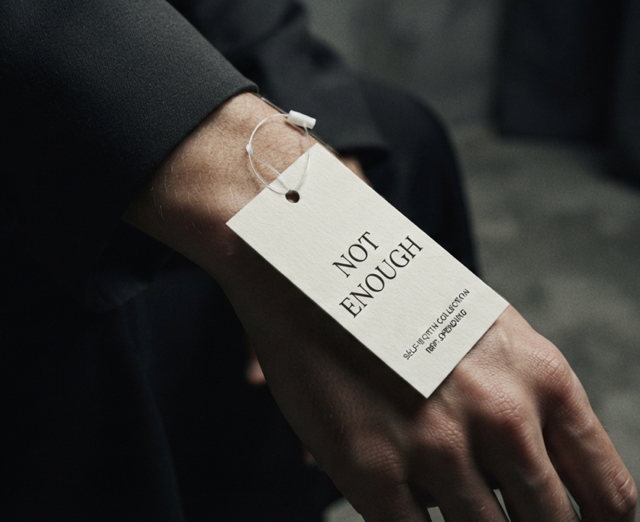
There is nothing wrong with owning beautiful things. A well-made watch, a car you love to drive, a home that feels like a sanctuary: these can bring real joy. This post is not about guilt, and it is not about giving everything away.
It is about one question: who is in charge, you or the things you own?
When an object becomes the proof that you matter, you are no longer enjoying it. You are using it to keep a fear quiet, and that fear is never satisfied.
The Invisible Hand In Your Wallet
Luxury marketing rarely sells a product. It sells a feeling about who you are when you own it.
More than a century ago, the economist Thorstein Veblen described "conspicuous consumption": buying things mainly so others can see you own them. He also noticed something strange. For some goods, demand goes up as the price goes up. The high price is the point. It signals that you belong to a class of people who can pay it.
Modern marketers have refined this into a science. A few of the levers being pulled on you every day:
Scarcity. "Limited edition." "Only three left." "Waitlist only." Psychologist Robert Cialdini showed that we value things more when they seem rare. Your brain treats a manufactured shortage as if it were a real one.
Identity selling. The ad doesn't show the handbag. It shows the confident, admired, effortless person carrying it. You are not buying leather; you are buying a version of yourself.
Social proof. Influencers, celebrities and the people in your feed show you what "people like us" own. We are wired to follow the tribe, because for most of human history being excluded meant death.
Manufactured lack. Effective advertising first makes you feel slightly incomplete, then offers the cure. The wound comes before the bandage.
None of this works on a person who already feels whole. It works because so many of us carry an old, quiet belief: I am not enough as I am.
Why The Thirst Never Ends
Researchers call it the hedonic treadmill. When we get something we wanted, our happiness rises, and then, usually within weeks or months, it returns to where it was. The new car becomes just the car. The bigger house becomes just the house. So we reach for the next thing.
Psychologist Tim Kasser spent decades studying what happens to people who organize their lives around money, image and status. His research and later large analyses found a consistent pattern: the more strongly people hold materialistic values, the lower their well-being tends to be. That means more anxiety, more depression, less life satisfaction and weaker relationships. The chase doesn't just fail to fill the hole; it tends to widen it.
There is a deeper reason. Psychologist Jennifer Crocker studied contingent self-worth, which is self-esteem that depends on meeting certain conditions. When your worth depends on appearance, status or approval, it is always under threat. Every comparison is a test, and every test can be failed. You can never rest.
Research on "self-completion" adds one more layer. People who feel insecure about part of their identity are more likely to display symbols of it. In other words, the louder the logo, the quieter the inner voice may be saying, please see me.
The Comparison Machine
Leon Festinger's social comparison theory explains that we measure ourselves against others to know where we stand. That instinct once helped us survive in small tribes, where we compared ourselves to maybe 150 people we actually knew.
Today we compare ourselves to millions of curated highlight reels. We see others' vacations, never their arguments. We see their new cars, never their debt or their lonely nights.
So we do the same. We post only our best moments, polished and filtered and perfect. Everyone performs for everyone, and no one feels seen. A 2018 study at the University of Pennsylvania found that students who limited social media use to about 30 minutes a day for three weeks reported meaningful drops in loneliness and depression. Perfection on display is exhausting, both to perform and to witness.
The tragedy is that real connection requires the exact thing the performance hides: imperfection. We bond through the cracks, not the polish.
Premium Fuel for the Car, Empty Fuel for the Body
Look at where the care goes.
We give our cars the best synthetic oil and wash them every Sunday. Then we feed our bodies food with almost no nourishment. We protect the phone with a premium case, while our nervous system runs on caffeine, stress and four hours of sleep. We insure the jewelry, but not our relationships, our health or our peace.
This is the clearest sign that something is inverted. When the object receives more care than the person, the person has started to believe the object is worth more.
What Actually Matters at the End
The Harvard Study of Adult Development has followed people for over 80 years, one of the longest studies of human life ever conducted. Its central finding is simple: the quality of our relationships is one of the strongest predictors of health and happiness as we age. Not wealth. Not status. Not possessions.
Nurses and hospice workers who sit with the dying tell similar stories again and again. People don't wish they had owned more. They wish they had loved more openly, worried less about others' opinions, and lived more truly as themselves.
When you take your last breath, the logo on your bag will mean nothing. The people who felt truly loved by you will mean everything.
Enjoy Your Things, Just Don’t Become Them
Here is the test. Imagine you lost every luxury item you own tomorrow. Would you still feel like you? Would your joy still be there?
If the answer is yes, enjoy your things fully. Drive the car with delight, wear the watch with gratitude. They are decorations on a life that is already whole.
If the answer is no, that is not a reason for shame. It is information. It points to an old wound, often from childhood, where love felt conditional on achievement, appearance or being impressive. The material thirst is not the problem; it is the symptom. And symptoms are homework.
Your worth was never for sale, so it cannot be bought. It was there before you owned anything, and it will be there after everything is gone.
So the real question is: do you want a meaningful life, or an artificial one?
Question to Sit With
Don't rush these. Read one, close your eyes, and notice what your body does before your mind answers.
If no one could ever see what you own, what would you stop buying, and what would you still keep?
When you were a child, what did you have to do or be to feel loved, noticed or "enough"? Does that same requirement still show up in what you buy, wear or post?
Think of your most prized possession. What feeling were you hoping it would give you? Did it last, and where else could that feeling come from?
Whose approval are you still trying to earn, and what would happen if you stopped?
What do you take better care of than yourself? What would change if you gave yourself that same care?
When was the last time you showed someone your imperfection, and felt closer to them because of it?
If your last breath came tomorrow, what would you wish you had spent your energy on? What is one small thing you can do about that today?
Who are you when you have nothing to prove?
If any of these questions brings up pain, that pain is not a sign that something is wrong with you. It is a sign of where healing wants to begin. Be gentle with yourself there. Consider talking it through with someone you trust or a qualified professional.