
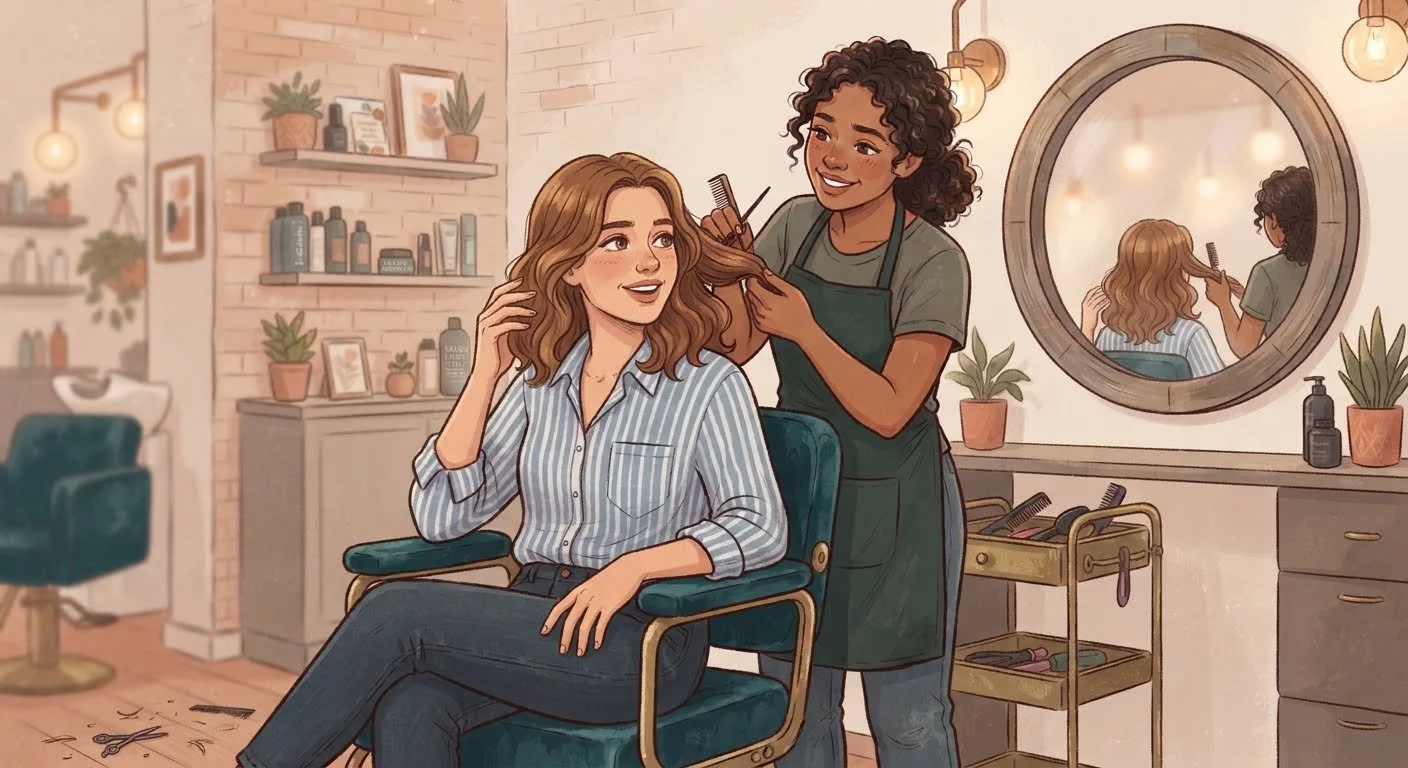
The Circle Is Upside Down
Think about the last time you sat in a barber's or hairstylist's chair.
Within twenty minutes, you may have talked about your marriage. Your fears about your kids. The business deal that is keeping you awake. The parent who is slowly fading.
Now think about the last time you told your partner any of that. Or your best friend. Or your brother or sister.
Somewhere along the way, the circle turned upside down. The people closest to us know the polished version. The people furthest away know the truth.
Our hairstylist knows more than our partner. Our random acquaintances know more than our friends. The stranger on the plane hears what our family never will.
This is not an accident. It is protection. And it is costing us far more than we realize.
Around The Fire Everyone Was Listened
For most of human history, we did not live this way.
In tribal life, people sat together and shared what they felt. The elders respected the young. The young respected the old. And everyone made sure the other was heard. Not judged. Heard.
In an earlier post, I wrote about Benjamin Franklin's 1784 essay, Remarks Concerning the Savages of North America. Franklin watched Native councils and was struck by how they listened. Whoever wished to speak would rise. In his words, "The rest observe a profound Silence."
No interrupting. No preparing your comeback while the other person is still talking. When a speaker sat down, the council waited a few minutes in silence, in case the speaker had forgotten something they wanted to add.
Franklin then compared this with the British House of Commons, where members talked over one another. The comparison leaves a quiet question: who were the real savages?
That is what vulnerability needs to survive. Not a perfect person. A safe circle.
What Soldiers Know
Ask a veteran about the best friendship of their life. Many will not name a childhood friend. They will name the soldier in the next foxhole.
Why? Because in the trenches, there was no room for the perfect picture. Soldiers who might die tomorrow shared their dreams, their fears, the person waiting back home, the parent they never made peace with. They saw each other at their worst and stayed.
Journalist Sebastian Junger spent years with soldiers and wrote about this in Tribe. He describes combat as creating a closeness between soldiers that most people never experience. His conclusion surprised many. For a lot of veterans, the deepest pain is not the war. It is coming home to a society where everyone keeps to themselves.
Read that again. Some veterans miss war. Not the danger. The closeness.
What does that say about the way the rest of us are living?
Why We Hide From The People That Matters Most?
We live in a marketing world. Everything is sold to us as perfect, so we learn to sell ourselves as perfect too.
The vacation photo on the beach gets posted. The sick child the next morning does not. The promotion gets announced. The panic attack in the car before the meeting does not. The anniversary dinner gets shared. The silence on the drive home does not.
We have become curators of our own lives, editing out everything that looks like weakness.
Harvard sociologist Mario Small studied who people actually turn to when life gets hard. In his book Someone To Talk To, he found that people often go out of their way to avoid close friends and family, because those relationships carry history and expectations. Instead, they confide in acquaintances and sometimes complete strangers.
It makes sense. The stranger has nothing to hold over us. The hairstylist will not bring it up at Christmas dinner. Our partner might see us differently. Our friend might think less of us.
So we protect the image with the people whose opinion matters most. And in doing so, we keep them from ever knowing who we really are.
The Pressure Builds Because We’re Designed For the Opposite?
We are social beings. Keeping everything inside goes against our design, and the body keeps score.
At Stanford, psychologists Emily Butler and James Gross paired strangers to discuss an upsetting film. One person was secretly told to hide her emotions. The results were striking. Hiding feelings disrupted the conversation, reduced rapport, and made a real connection less likely. The blood pressure of the person across the table rose too.
Think about that. When you hide what you feel, the people around you feel it in their bodies. Your partner senses the wall even when you are smiling. Your children feel it. Nobody is fooled. Everybody is just more tense and more alone.
And the cost compounds. In 2023, the U.S. Surgeon General issued an advisory on loneliness, led scientifically by psychologist Julianne Holt-Lunstad. It found that lacking social connection raises the risk of early death about as much as smoking up to 15 cigarettes a day.
This is the paradox of the high achiever. We build the life we dreamed of. Then we live inside it alone, behind a perfect image, wondering why success feels so empty.
It is not the success that is empty. It is the hiding.
Your Mess Looks Beautiful From The Outside
Here is the good news. The fear is lying to you.
In 2018, psychologists Anna Bruk, Sabine Scholl and Herbert Bless at the University of Mannheim published seven studies in the Journal of Personality and Social Psychology. They looked at moments like confessing love, asking for help, and admitting a mistake.
Again and again, people judged their own vulnerability as weakness. Yet when they watched someone else do the exact same thing, they saw courage. The researchers called it the beautiful mess effect.
Why? When it is us, we zoom in on every detail: the shaky voice, the face we will make, the awkward seconds after. When it is someone else, we step back and see the bigger picture: a person brave enough to be real.
So the very thing you are hiding to protect your image is the thing that would make people trust you, respect you, and love you more.
There is no good or bad in what you are hiding. There is only humanity. The people dear to you deserve to know all of it, because that is how they get to know you.
Questions To Sit With
Do not rush these. Read one, then close your eyes. Notice what your body does before your mind answers. The discomfort is not a problem. It is homework pointing to what needs healing.
Who knows the real you right now? Not the version you present. The real one. Count them. Is the number smaller than you expected?
Think of something you have told a stranger or acquaintance but never told your partner or closest friend. What exactly are you afraid would happen if they knew?
When did you first learn that showing your feelings was not safe? Who was in the room? How old were you?
That younger version of you built a wall to survive. Is that wall still protecting you today, or is it now keeping out the very people you love?
If someone you deeply respect shared your biggest struggle with you, would you think less of them? Then why do you believe they would think less of you?
What would your relationships look like a year from now if the people closest to you knew both your light and your shadow?
Who in your life might be waiting for you to go first?
If these questions open old wounds that feel too heavy to carry alone, that is a sign of strength, not weakness. Reach out to a counsellor or therapist who can walk with you.
The Exercise: The Council Circle
This practice combines the listening of the ancient council with modern research. In 1997, psychologist Arthur Aron showed that strangers who took turns sharing gradually deeper answers felt far closer after 45 minutes than pairs who made small talk. The key was that both people opened up, step by step, at the same pace.
Do it with a friend, your partner, or a group of up to eight. Plan about 45 minutes.
The agreements (read them out loud before you begin):
What is said in the circle stays in the circle.
One person speaks at a time. Hold an object, such as a stone or a cup, while you speak. Everyone else listens in silence.
No advice, no fixing, and no "that happened to me too" while someone is sharing.
Anyone can say "pass" at any time, with no explanation needed.
The three rounds:
Each person answers the round's question for two to three minutes. When the speaker finishes, the circle sits in silence for a full minute, just like Franklin's council, in case the speaker has more to say. Then the next person takes the object.
Round one, the surface: "Something people often assume about me that isn't quite true is…"
Round two, the edit: "A moment from my life I would never post on social media, and what I was really feeling, is…"
Round three, the wall: "Something I have carried mostly alone, and what I wish the people close to me understood, is…"
The closing round:
Go around one last time. Each person turns to the person who spoke before them and completes this sentence: "What I saw in you today was…"
Notice the word saw. Not what they did wrong. Not what they should fix. What you saw. Most people discover that what they were most afraid to share is exactly what made others see them as brave.
That is the beautiful mess, in real life.
Turn the Circle Right Side Up
You do not need a war to find your brothers and sisters. You do not need a tribe in the forest to be heard.
You need one honest conversation with someone who matters. Then another.
Let your partner know what your hairstylist knows. Let your friends see what you hide from the camera. Not because it is easy, but because it is how we were designed to live.
The perfect picture never healed anyone. Being truly seen does.