
#37 | The Cosmic Calculator: How the Fibonacci Sequence Proves the Universe Has a Blueprint
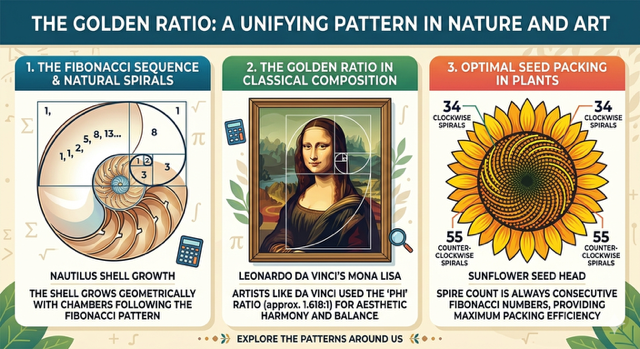
The Cosmic Calculator: How the Fibonacci Sequence Proves the Universe Has a Blueprint
Look closely at the back of a simple pinecone. Follow the spiral pattern of its scales from the center outward. If you count those spirals, you will almost always hit a specific set of numbers: 5, 8, 13, or 21.
This is not a random coincidence. It is the signature of the Fibonacci sequence, a mathematical code woven tightly into the fabric of reality.
From the elegant curve of a blooming flower to the majestic swirl of a distant galaxy, our world is not a chaotic accident. It is a highly calculated masterpiece engineered with absolute perfection, ensuring balance across our climates, ecosystems, and the cosmos.
The Content of Creation
The Fibonacci sequence follows a remarkably simple rule: start with 0 and 1, then add the last two numbers together to get the next.
$$0, 1, 1, 2, 3, 5, 8, 13, 21, 34, 55, 89...$$
When you divide any number in this sequence by the one before it, you approach an ideal ratio: 1.618. Mathematicians call this the Golden Ratio.
When translated into geometric shapes, this ratio forms a logarithmic spiral. This specific spiral is the universe's favorite blueprint, serving as a master key that unlocks maximum efficiency in physical space.
Botany’s Hidden Efficiency
Nature uses this math out of absolute necessity. In the plant kingdom, survival requires calculated optimization.
Sunflowers: The seeds in a sunflower head are packed in overlapping Fibonacci spirals. This mathematical arrangement allows the plant to cram the maximum possible number of seeds into a tight space without crowding.
Tree Leaves: Branches sprout along stems at precise fractional turns matching Fibonacci fractions. This deliberate spacing ensures that upper leaves never completely block sunlight or rain from reaching the leaves directly below them.
Pineapples and Succulents: The dense, armor-like spirals of a pineapple or the compact petals of an aloe plant rely on the Golden Ratio to grow seamlessly without changing their underlying geometric shape.
The Blueprint of the Heavens
If you leave Earth and zoom out into the vast emptiness of outer space, the exact same mathematical spiral appears on a staggering scale.
Our own home, the Milky Way, is a spiral galaxy. Its massive arms of stars, gas, and cosmic dust curve outward at the exact angle dictated by the Golden Ratio. The universe uses the identical geometric formula to shape a microscopic seashell on a beach and a galaxy spanning 100,000 light-years across. It reveals a deeply ordered cosmic architecture.
Perfection in Earth’s Climate & Ecosystems
This mathematical order extends directly into the invisible systems that keep our planet alive. Earth's climate and ecosystems are carefully balanced webs driven by calculated physical forces.
The Dynamic of the Strong Weather
The Golden Spiral dictates the terrifying geometry of hurricanes and typhoons. As warm air rises and the planet rotates, the storm organizes itself into a tightly wound Fibonacci spiral. This shape is the most thermodynamically efficient way for a massive storm system to release energy, showing that even atmospheric chaos follows strict mathematical rules.
The Equilibrium of the Ecosystems
Ecosystems rely on this precise structural balance to maintain life.
The Food Web: Predator-to-prey ratios naturally trend toward stable mathematical constants over time. If a predator population grows too large, resource scarcity forces it back into a balanced equilibrium.
Resource Allocation: The flow of water through a river delta mirrors the branching patterns of blood vessels in our lungs and veins in a leaf. This fractal distribution ensures that nutrients and water are delivered across the landscape with maximum efficiency and minimum waste.
A World by Design
When we look at the climate, the seasons, and the delicate balance of our ecosystems, we are witnessing a global calculus engine at work. The presence of the Fibonacci sequence across every scale of reality proves that nature does not guess.
The universe is built on foundational law, mathematical precision, and absolute geometric perfection. We live inside a beautifully calculated masterpiece.
Questions to Awake Curiosity
Were you aware that a simple mathematical sequence connects a sunflower to a spinning galaxy?
When you look at nature, do you see chaotic randomness or a deeply organized blueprint?
How does it feel to know that your own body and the world around you run on the exact same geometric code?
Does knowing the universe is so perfectly calculated give you a sense of peace or wonder?
What is one place in your daily life where you might start looking for hidden mathematical spirals?